'%20d='M35.1527%2028.5549L35.1527%2069L17.6979%2069L17.6979%2028.5549L-0.162012%2028.5549L-0.162012%2014.6489L52.9354%2014.6489L52.9354%2028.5549L35.1527%2028.5549ZM108.55%2031.313Q108.55%2036.2891%20105.85%2040.3201Q103.169%2044.3511%2098.0385%2046.2412L110.132%2069L90.5358%2069L80.8923%2049.1729L74.4118%2049.1729L74.4118%2069L56.957%2069L56.957%2014.6489L90.2272%2014.6489Q96.0712%2014.6489%20100.218%2016.9055Q104.365%2019.1428%20106.448%2022.981Q108.55%2026.8191%20108.55%2031.313ZM90.7673%2032.0266Q90.7673%2029.8857%2089.34%2028.4778Q87.9321%2027.0505%2085.8684%2027.0505L74.4118%2027.0505L74.4118%2037.0798L85.8684%2037.0798Q87.9321%2037.0798%2089.34%2035.6333Q90.7673%2034.1675%2090.7673%2032.0266ZM150.883%2069L148.607%2061.343L129.551%2061.343L127.276%2069L109.416%2069L129.243%2014.6489L149.552%2014.6489L169.379%2069L150.883%2069ZM133.197%2049.1729L144.962%2049.1729L139.272%2029.8086L138.964%2029.8086L133.197%2049.1729ZM210.844%2069L188.028%2042.6152L188.028%2069L171.981%2069L171.981%2014.6489L187.237%2014.6489L210.054%2041.4194L210.054%2014.6489L226.101%2014.6489L226.101%2069L210.844%2069ZM256.674%2013.7039Q267.108%2013.7039%20273.82%2017.9277Q280.532%2022.1516%20280.686%2030.4451L280.686%2031.3901L264.331%2031.3901L264.331%2031.0815Q264.331%2028.7092%20262.595%2027.1277Q260.859%2025.5461%20257.31%2025.5461Q253.819%2025.5461%20251.968%2026.5876Q250.116%2027.6099%20250.116%2029.1143Q250.116%2031.2358%20252.643%2032.2773Q255.169%2033.2996%20260.782%2034.3989Q267.34%2035.749%20271.564%2037.2148Q275.787%2038.6614%20278.951%2041.9788Q282.114%2045.2961%20282.191%2050.9858Q282.191%2060.6294%20275.672%2065.2969Q269.153%2069.9451%20258.255%2069.9451Q245.526%2069.9451%20238.448%2065.6826Q231.388%2061.4202%20231.388%2050.6001L247.898%2050.6001Q247.898%2054.7083%20250.02%2056.0969Q252.161%2057.4663%20256.674%2057.4663Q259.991%2057.4663%20262.151%2056.7527Q264.331%2056.0391%20264.331%2053.8403Q264.331%2051.8538%20261.92%2050.8701Q259.509%2049.8865%20254.07%2048.7678Q247.435%2047.3599%20243.076%2045.8169Q238.737%2044.2739%20235.497%2040.7251Q232.256%2037.157%20232.256%2031.0815Q232.256%2022.1516%20239.161%2017.9277Q246.085%2013.7039%20256.674%2013.7039ZM312.848%2013.7039Q324.922%2013.7039%20331.942%2019.7407Q338.982%2025.7776%20338.982%2037.0027L322.318%2037.0027Q322.318%2032.2581%20319.83%2029.5Q317.342%2026.7419%20312.751%2026.7419Q307.467%2026.7419%20304.979%2030.0593Q302.491%2033.3767%20302.491%2039.2979L302.491%2044.3511Q302.491%2050.1951%20304.979%2053.551Q307.467%2056.907%20312.597%2056.907Q317.65%2056.907%20320.254%2054.3032Q322.877%2051.6995%20322.877%2046.9548L338.982%2046.9548Q338.982%2058.1028%20332.154%2064.0239Q325.327%2069.9451%20312.848%2069.9451Q298.942%2069.9451%20291.786%2062.8474Q284.631%2055.7305%20284.631%2041.8245Q284.631%2027.9185%20291.786%2020.8208Q298.942%2013.7039%20312.848%2013.7039ZM396.031%2031.313Q396.031%2036.2891%20393.331%2040.3201Q390.65%2044.3511%20385.519%2046.2412L397.612%2069L378.017%2069L368.373%2049.1729L361.893%2049.1729L361.893%2069L344.438%2069L344.438%2014.6489L377.708%2014.6489Q383.552%2014.6489%20387.699%2016.9055Q391.846%2019.1428%20393.929%2022.981Q396.031%2026.8191%20396.031%2031.313ZM378.248%2032.0266Q378.248%2029.8857%20376.821%2028.4778Q375.413%2027.0505%20373.349%2027.0505L361.893%2027.0505L361.893%2037.0798L373.349%2037.0798Q375.413%2037.0798%20376.821%2035.6333Q378.248%2034.1675%20378.248%2032.0266ZM402.741%2069L402.741%2014.6489L420.195%2014.6489L420.195%2069L402.741%2069ZM459.224%2014.6489Q464.277%2014.6489%20468.231%2016.9827Q472.185%2019.3164%20474.383%2023.386Q476.602%2027.4556%20476.602%2032.5088L476.602%2033.531Q476.602%2038.5842%20474.383%2042.6924Q472.185%2046.8005%20468.231%2049.1343Q464.277%2051.468%20459.224%2051.468L446.186%2051.468L446.186%2069L428.731%2069L428.731%2014.6489L459.224%2014.6489ZM446.186%2038.7385L453.38%2038.7385Q456.138%2038.7385%20457.527%2037.3306Q458.915%2035.9033%20458.915%2033.4539L458.915%2032.8174Q458.915%2030.2908%20457.527%2028.9214Q456.138%2027.5327%20453.38%2027.5327L446.186%2027.5327L446.186%2038.7385ZM513.103%2028.5549L513.103%2069L495.648%2069L495.648%2028.5549L477.788%2028.5549L477.788%2014.6489L530.885%2014.6489L530.885%2028.5549L513.103%2028.5549Z'/%3e%3c/svg%3e)

You recorded a killer podcast episode. Great conversation, useful insights, maybe even some viral-worthy moments. Then it goes up on Spotify and Apple Podcasts, gets its downloads in the first week, and... that's it. It lives and dies in the podcast feed.
Meanwhile, a blog post on the same topic could be driving Google traffic for months or years. The difference? Text content is searchable. Audio (mostly) isn't.
Search engines have gotten better at surfacing podcast content, but we're nowhere near a world where audio ranks the way text does. If you want your podcast ideas to show up in search results, you need them in written form.
The good news: you don't have to write from scratch. The content already exists, you just need to transform it from spoken word to written word.
Why Podcasters Need Written Content
Let's be blunt about the discovery problem with podcasts.
Most podcast discovery happens through word of mouth and platform recommendations. Those channels work, but they're limited and hard to control. You can't optimize for "the algorithm recommends me" the way you can optimize a blog post for a specific keyword.
A blog post, on the other hand, can rank for a search query and drive traffic indefinitely. Someone searches "how to start a newsletter" on Google, finds your blog post (which is based on your podcast episode about starting a newsletter), reads it, discovers your podcast, and subscribes.
This is the flywheel: podcast creates content, blog post captures search traffic, search traffic drives new listeners, new listeners grow the podcast.
Other benefits of turning episodes into posts:
- Backlink opportunities. Other sites link to blog posts. They rarely link to podcast episodes.
- Social sharing. Blog posts are easier to share and preview on social media than audio links.
- Email content. Blog posts can be repurposed into newsletter content.
- Accessibility. Not everyone listens to podcasts. Some people prefer reading.
- Content archive. A blog creates a browsable, searchable archive of your best ideas.
The Bad Way: Publish the Raw Transcript
Let's address this upfront because a lot of people try it. The idea is tempting: just transcribe the episode and publish the transcript as a blog post. Minimum effort, maximum output. Right?
Wrong. Raw transcripts make terrible blog posts. Here's why:
Spoken language is messy. People repeat themselves, use filler words, go on tangents, and circle back. What sounds natural in conversation reads like a mess on screen.
No structure. Conversations don't follow blog post structure. There are no headers, no clear sections, no logical progression from point A to point B.
SEO is weak. A raw transcript is just a wall of text. No headers means no keyword signals. No formatting means high bounce rate. Google won't rank it well.
Reader experience is awful. Imagine reading 5,000 words of unedited conversation. Nobody does that. They bounce in 10 seconds.
The transcript is your raw material, not your finished product. It needs editing, restructuring, and formatting before it's ready to publish.
The Right Way: Transcript to Blog Post in 5 Steps
Step 1: Get the transcript
First things first. Your options:
Descript - Upload the audio, get a transcript. The editor makes it easy to clean up as you go. Popular among podcasters who also edit in Descript.
Otter.ai - Good for interviews with speaker labels. Free tier handles shorter episodes.
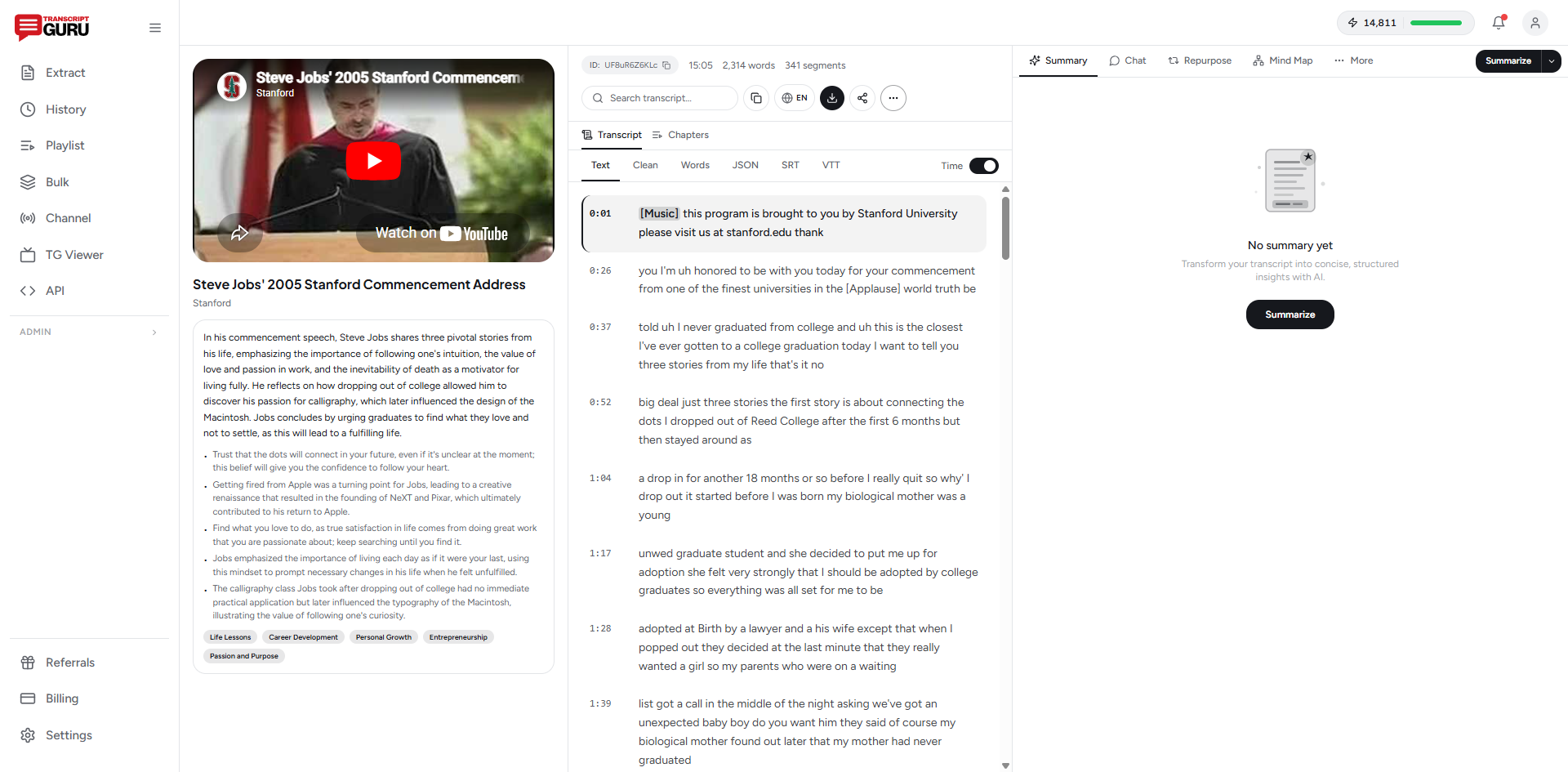
Transcript Guru - If your podcast is on YouTube (and most shows now publish there too), paste the URL and get a transcript in seconds, for free. It also generates blog drafts as a repurposing option, which gives you a head start on Step 3. Here's a full guide to transcribing a YouTube video to text.
Human transcription - Per-minute human services (like Rev) give the most accurate result, at a higher cost. Worth it when accuracy is critical.
Whisper - Open-source, free, high accuracy. Requires technical setup.
Step 2: Pick the angle
A podcast episode usually covers multiple topics. A blog post should focus on one.
Read through the transcript and ask: "What's the one thing someone would Google that this episode answers?" That's your blog post topic.
For example, if your episode is a 60-minute interview where you discuss marketing strategy, hiring, and product development, you don't write one blog post covering all three. You write three separate posts, each focused on one topic.
This is actually a huge advantage of the podcast-to-blog approach: one episode can generate multiple blog posts.
Step 3: Build the outline
Take the relevant sections of the transcript and organize them into a blog post structure:
- Title - Something searchable. "How to [do thing]" or "[Number] ways to [achieve result]"
- Introduction - Set up the problem. Why should the reader care?
- Main sections (3-5) - Each with a clear header. Each making one point.
- Conclusion - Recap and next steps.
You're not following the conversation order. You're reorganizing for readability. The best insight from minute 38 might become your opening paragraph.
Step 4: Edit spoken into written
This is the most important step and where most people cut corners.
Go through each section and:
- Remove filler. Cut "like," "you know," "basically," "right?" and every "so" that starts a sentence.
- Tighten sentences. Spoken sentences are 30-40 words. Written sentences should be 15-20. Cut the fat.
- Add transitions. In conversation, people just move on to the next topic. In writing, you need bridges between sections.
- Fix repetition. Speakers repeat key points for emphasis. In text, say it once and say it well.
- Add context. The listener had your tone and inflection for context. The reader only has words. Add clarifying phrases where meaning might be ambiguous.
If you're using AI to help with this step, paste the relevant transcript section and ask it to "rewrite this spoken content as a blog post section. Keep the original ideas and examples but clean up the language for reading. Use headers."
Step 5: Add SEO elements
Before publishing, add:
- Title tag - Include your target keyword. Keep under 60 characters.
- Meta description - 150-160 characters summarizing the post.
- Headers (H2, H3) - Use keywords naturally in headers.
- Internal links - Link to related blog posts or episodes.
- Embedded player or episode link - Give readers an easy way to listen to the full episode.
- Images or visuals - Even just a featured image. Blog posts with images get more shares.
Get a clean podcast transcript in seconds
Get Started FreeThe AI-Assisted Shortcut
The manual process above takes about 45-60 minutes per blog post. Here's the faster version:
- Get the transcript (2 minutes)
- Paste into ChatGPT/Claude with: "Turn this podcast transcript into a blog post. Clean up spoken language, add headers, make it SEO-friendly for the keyword [X]. Keep the original examples and insights." (1 minute)
- Review and edit the AI draft (15-20 minutes)
- Add SEO elements and publish (5 minutes)
Total: about 25 minutes. The AI handles the tedious cleanup work. You handle the editorial judgment, what to keep, what to cut, what to emphasize.
Tools like Transcript Guru combine the first steps by offering blog draft generation directly from the transcript. You get a structured draft without the copy-paste-to-ChatGPT dance.
How Often Should You Do This?
Not every episode needs to become a blog post. Focus on:
- Evergreen topics - Content that'll still be relevant in 6-12 months
- Searchable topics - Things people actually Google. Use a keyword tool to check volume.
- Your best episodes - High download count usually means the content resonated
A good cadence for most podcasters: turn 2-3 episodes per month into blog posts. That builds up a meaningful archive over time without burning you out.
The Compound Effect
Here's why this strategy is worth the effort: blog posts compound. A podcast episode gets most of its downloads in the first week. A blog post can gain traffic over months as it climbs in search rankings.
After a year of converting 2-3 episodes per month, you'll have 24-36 blog posts, each one a potential entry point for new listeners. Some will rank on page one for their target keywords. Some will get shared on social media. Some will get backlinks from other sites.
All of that drives traffic to your podcast in a way that pure audio distribution never will. The written web is still where discovery happens for most people, and your podcast content is already good enough to compete. It just needs to be in the right format.
Start With One Episode
Pick your best episode from the last three months. Get the transcript, outline it, edit it into a blog post, and publish it. Track the traffic over the next 30 days.
If you want to speed up the process, Transcript Guru generates blog drafts directly from YouTube podcast URLs. Transcript extraction is free and unlimited; the blog-draft generation uses AI credits, and the free plan includes 20 per month.
Keep reading
- How to Generate Show Notes From a Podcast Automatically
- How to Repurpose YouTube Videos Into Social Media Content
- How to Summarize a YouTube Video With AI
Frequently Asked Questions
Can I just publish the raw transcript as a blog post?
You can, but it will underperform. Spoken language is repetitive and unstructured, so a raw transcript reads poorly and lacks the headers and formatting search engines reward. Use the transcript as raw material, then edit it into real prose.
How long does it take to turn an episode into a post?
Manually, about 45 to 60 minutes per post. With AI doing the first-draft cleanup from the transcript, roughly 25 minutes: a couple of minutes to get the transcript, one to prompt, then 15 to 20 minutes of editing and SEO.
How many blog posts can one episode produce?
Often more than one. A 60-minute interview that covers three distinct topics can become three focused posts, each targeting a different search query, instead of one unfocused article.
Does turning podcasts into posts actually drive traffic?
Yes, over time. An episode gets most of its downloads in week one, but a well-optimized post can keep climbing in search and pulling in new readers (and listeners) for months. Text is what search engines rank.
Ready to try it yourself?
Extract transcripts, generate summaries, and repurpose content, free to start.
Start FreeRelated Articles
How to Generate Show Notes From a Podcast Automatically
Mar 22, 2026
TranscriptionHow to Transcribe a YouTube Video to Text (Free, No Software)
Jun 1, 2026
Summaries & AIHow to Summarize a YouTube Video With AI (Without Watching It)
May 28, 2026
TranslationHow to Translate YouTube Subtitles Into Any Language
May 24, 2026